Showing posts with label Mexico. Show all posts

Wednesday, November 2, 2016

Mala Mujer ~ Bad Woman


With the help of some important little messengers of late, I’m beginning to see that Mexico did not treat me very well.  

“As a single and childless woman, you’re an oddity. They don’t know what to do with you,” said Elizabeth, a new friend and client who’d lived and worked in Mexico for eight years. She regaled me with stories of her alienation, even working with the good guys in reproductive health, even in Mexico City, despite her fluency in Spanish. "Until I got married and had kids. Then, miraculously, I got some respect."

How could I know that the very untethered state that allowed me to wander off for two years to be of service would doom me?

I was a mala mujer down to the core. I lived alone in my apartment on Diaz and I bought wine at the Bodega Aurerra (Mexican Walmart) and I used tampons, which you could only get in boxes of 10, available only from behind the pharmacy counter, on the upper shelf, out of harm’s way, where a sales associate had to retrieve them for you. God knows what manner of shameful behavior was going on behind my closed apartment door.

According to Octavio Paz, the ambassador, poet, and Nobel Prize winner for his renowned book of essays, The Labyrinth of Solitude, “the mala mujer – the ‘bad woman’ – is almost always accompanied by the idea of aggressive activity. She is not passive like the ‘self-denying mother,’ the ‘waiting sweetheart,’ the hermetic idol: she comes and goes, she looks for me and then leaves them. Her extreme mobility…renders her invulnerable. Activity and immodesty unite to petrify her soul.” (Labyrinth)

Wow! I read his piece on Mexican Masks over and over, intrigued, mind-boggled, referring back frequently to my highlights and margin notes that bloodied the pages. But I could not, at the time, see how I how was fighting the unspoken label to curry favor with my counterparts and, in doing so, was losing me. I was too close to it. And if I had seen and acknowledged the kind of discrimination thwarting me at every turn, I would have had to surrender, take a Peace Corps ET (Early Termination), and head back across the border where I belonged.

Perhaps this was why, despite my ambivalence about being home those first weeks and months of my Returned PCV status, a cauldron of profound elation, at moments, was bubbling inside me.
 I remember the first night I ventured up to Mount Pleasant Street for a glass of wine at the local watering hole. Glass of wine. Even the words filled me with a sense of other-worldly appreciation as I stepped in the door as was met with a rush of body warmth and din of merriment. I sat tall in my stool, like a big girl, as the bartender came right over and laid a coaster before me.  I was mesmerized by the lengthy, laminated list of possibilities, Pinot, Merlot, Riojo. 

I couldn’t possibly decide; so Will the bartender recommended the Rhone and gave me a taste before filling my glass to the rim.  It was a late winter in Washington, and every time the door opened, a waft of frigid air swept in and gave me a shiver of exhilaration down to my frozen toes. After two and a half years in a desert, I felt profound thanks for the bone-chilling cold. 

As I sipped my ruby wine, taking in bombardment of English chatter, a waiter suddenly appeared a flatiron pan held high over his head. He lowered it and lit a Bic lighter to it and the pan exploded into flames. The entire establishment erupted in applause; cheese flambĂ© was cause for celebration in Mount Pleasant, USA. My eyes must have been popping out of my head as the waiter set the bubbling halloumi on the bar because the couple next to me smiled and offered me a bite. 

At El Fenix, my local watering hole in Rioverde, other than Rita’s brightness and the merry mariachi music whining over the sound system, a solemnity pervaded, a sense that those of us there, sipping our cervezas and michaladas (only beer-based drinks served), were hiding our sins from the rest of the world, behind the smoke colored glass. We were the scorned ones. And I would not have been welcomed if it hadn’t been for the fact that the owner and bartender was a woman and fast becoming my best friend. 

Now talk about a mala mujer. Rita was not only single and childless, but a cantina owner on top of it, serving up the diablo’s brew, and Dios only knew what else. But she didn’t care what they thought. She’d lived through the death of her father at age 12 and abandonment of her mother at 15. Left to raise her four younger sisters, she crossed the border, worked as a domestic, and sent the money back home. Even then the neighbors in her community cursed the Garcia girls:  You’ll all grow up to be bunch of putas. They did not. They learned how to survive the small town fires. Pueblo pequeno, infierno grande.

Once I found Rita, and she found me, we did not let go. I became her protection – because “Nobody gonna touch me when I have the gringa by my side.” And she became mine, because nobody would or could explain the inner workings of the pueblito and make me feel better for feeling so useless as Rita. Suddenly I felt not so alone.

So can you see I’m only just beginning to understand all this? To survive my time in Mexico I had to stuff the fears down and put on my Mexican mask and carry-on. My ingrained American optimism, in the face of challenges, also served, or it suckered me. 

A year and a half after I left Rioverde my friend Rita risked life and limb to cross over the border again. It took her three months and close to 10,000 dollars, money saved up for El Fenix and her sister’s house-cleaning business in Dallas going into the hands of the narcos, not just dealing in drugs anymore, but much more lucratively, in people.  On her journey she was jailed twice, and the final time held in a motel room with 12 other migrants for weeks until the coyotes decided it was her turn, until her sister was so desperate that she would agree to a doubling of the fee upon drop-off or never see her sister again.

That’s how bad Rioverde was for single women.

As my writing partner, Julie Gabrieli, put it on a recent check-in call, “We’re good at talking about the lipstick, but what about the pig? There’s only so much you can do if you are forced into a system that is fundamentally broken.” 

What IS ‘The Story of Sustainability from South of the Border,’ really?  I’ve been getting closer to the truth, moving away from my initial yearning to make it a story with a happy ending and, thus, justify my 2 years and 3 months’ investment in PCMX at the peak of my career. 

But underneath it all I’m still blaming myself. I was the demanding exijente gringa, pushing for change when they weren’t ready, not honoring the cultural norms, fighting the paternalism ineffectively, and even deeper, bringing my history and baggage of issues with the ‘father’ inappropriately into my Mexico service. "Life is a fight and I am alone."

I don’t want to put lipstick on a pig, and I don’t want to be a whiner. I want to share the truth of the experience:  the good, bad and beautiful. I want to discuss the darkness of the culture and the experience and also the light.  Because there was light.

I stuck it out and met Angelica and the Zama Mamas and we did something together that was pretty extraordinary.  I don’t know if it was sustainable.  I have not been in touch with them.  I’ve been too afraid to find out.  I stuck it out and met Rita and made a friend for life. And I cannot say I wasn’t at least an indirect influence on her decision to cross the border and make a more sustainable and happy life for herself with her sister on this side of the border. I stuck it out and met Professor Fernando Nino and had the opportunity to teach his engineering students about sustainability and innovation and open their eyes to what’s possible.   

But mostly I stuck it out. Now coming on four years since the completion of my service, I may be just be getting glimpses of what it all meant.

Tuesday, September 27, 2016

The Heart of Memoir

I had the good fortune, last week, to attend a book talk by my memoir hero, Mary Karr. Her first memoir, The Liars’ Club, opened my eyes, back in the 90s, to what’s possible with the form, joy and pain in the unvarnished truth, through the eyes of a child.

I began to devour memoirs back then (Nabokov, McCourt, Welty, Woolf and Wolfe), developing a quiet aspiration to tell my own story someday.

The other night, at Busboy & Poets, amidst a packed house, I devoured the author’s nuggets of wisdom on the craft, a few of them harder than others to swallow, washing them down with sips of mojito.

Mary Karr & Busboys & Poets
First and foremost, she told us, find your voice as a memoirist, the most interesting version of yourself. And yes, she clarified, it’s made-up.

I haven’t found that voice for Mexico yet, though I have heard it in fragments here and there.
Write (even the people you hate) with as much love as you can, said Karr.

For me that means the corrupt mayor, Don Bruno, the paternalistic Peace Corps bosses, the machismo engineers, the gossipy, dismissive Consejo. The whole cast of characters with love?

She also said: From the second you choose one event over another you’re shaping the past’s meaning. It’s a hell of a lot of responsibility.

She went on to say that sometimes you have to write a ton to get past the pages that don’t belong, like I did the first 100 pages of my Mexico book. But that’s nothing. Karr told us she had to lop-off 1200 pages of her memoir, Lit, before it set right. The DELete key is my most important tool.
 
During the Q&A, I forced myself to raise my hand. I stood-up and posed a question into the microphone. I had a million, but the one that won out was about my challenges writing and completing the story of my Peace Corps Service. ‘I got back in 2013,’ I told her. ‘Do I need more distance from the events?’ Here was my chance for some answers. (I mentioned, incidentally, that I had my Kickstarter backers – like an agent collective – waiting for the finished product.)

‘Oh, that’s tough,’ she acknowledged, and graciously thanked me for my service. Then she answered my question with a question:

‘Is there some way in which you were meant to change through the experience and didn’t OR some way you changed and aren’t ready to claim? Explore that.’

‘Yeah, do I have to?’ I grumbled under my breath, feeling my face turn red hot, and sat back down like a kid who’d gotten the answer (or in this case the question) wrong.

Okay, I admit, there’s stickiness there, like dried soda pop on the kitchen floor, and I keep stepping in it. I’m the President of SeeChange, for godsakes. I should have known better, done better, if not in changing Mexico, at least in changing my self.

What pops to mind is an infamous line of my mother’s, worn in to grooves of my record so it keeps repeating: ‘I have great things in mind for my daughter and I don’t want you fucking them up.’ Back then the you was a man. Now it’s universal, anyone (including me) that might get in my way.

Then I think of my wise and concerned friend, J, who tried coaching me through a rough patch in my service when the local board of sustainability to which I was assigned turned on me and the Peace Corps threatened to throw me out. ‘Has it occurred to you,’ J posed over Skype at about my six-month mark in Mexico, ‘that this experience could be doing you more harm than good?’

No, no, no, he didn’t get it. My friend was in development, yes, but a policy wonk, a diplomat, jet-setting around the world to negotiate treaties and wine and dine with the powers that be. On the ground work was a different ball game. He just didn’t get it.

But in the end, had he been right? I had (hidden) aspirations to change the world, at least a small corner of it. I had stuck it out, two years and three months. But what had I accomplished? Returning home to DC, I was back in the same old place, maybe I’d even gone a few giant steps backwards.

I don’t want to tell that tale, a story of disillusionment. But it’s there. Ways I hoped to change and didn’t. Ways I changed and don’t want to see. Can I face them? Can I handle the truth with tenderness? Can I see beyond the parternalismo and machismo and corruption, and my own getting in the way, to recognize that I did do some good, maybe even some ‘great things’?

F. Scott Fitzgerald says the definition of intelligence is the ability to hold two opposing truths simultaneously. When I’m there, I’ll be ready to write. Or perhaps I write to get there.

Mary Karr's new book is called The Art of Memoir and can be found on Amazon or her website http://www.marykarr.com/books.php.

Sunday, August 7, 2016

Mexican Mask

I realized on the cushion this morning (a habit I’ve pledged to re-begin for the entire month of August): I’m not fixing anything on this spiritual path. I’m just uncovering who I really am. I could feel my shoulders relax and my monkey mind calm at the thought.

I’ve been hiding her, as if ashamed, afraid of her power. She tugs on my skirt. It’s the me who, in first grade, could have 'run this entire school,' so said my teacher Miss Casula. It’s the me who stood up to my bully father. And after seeing him back down, a sheep in wolf's clothing, nothing was the same.

‘Remember?’ the little girl says, looking up at me.

That girl’s got things to do, places to go, works to create, truths to proclaim.

Nina Volando

Though the messages of the past ring-out like it was just yesterday: Don’t upset your father, don’t overshadow your sister, take care of your little brother, don’t ask too much of me. 

That’s Mom’s voice:  subtle, demure, just like her, never showy or direct. She probably had no idea she was sending such messages: a scowl of admonishment when I demanded she look at my art collage, a pat of approval when I sat still in front of the nightly news, a song of praise when I cleared the dinner table. I would do anything to please my Mom. She is in me now.
But if, over time and years of therapy and re-parenting, I had rebuilt some of my youthful power, it got knocked back out of me in Mexico, immersed, submerged as I was in a culture of paternalism and machismo.

I had to plead with the mayor: ‘Deja me trabajar,’ let me work! I was becoming one with the people in their struggle against the powers that be. After the news came from the Peace Corps bosses that I would be transferred to the capital or sent back home, I had to scramble. I would not, could not go. I needed the support of the townspeople. Surely they’d prefer I stay and try to do some good in their pueblo. Surely they would make the case for me.

‘Si, seguro,’ yes, of course, Anna, assured the Mayor's right hand man. I had prepared the sustainability training for the city functionarios, a task to make myself useful, justify my existence. This would be my chance to show my value. I had my PowerPoints translated, my exercises defined and my script ready, and I’d gotten myself mentally psyched-up to face my audience across the language divide. But again and again, the training had been postponed.

I was beginning to learn: Yes is not really a yes, guerrita, little white woman.

I had to be relentless, come back again and again, careful not to show any sign of weakness. Though simply forcing myself to wait in a chair outside the mayor’s office, and being passed over three or four times while continuing to smile and make small-talk with the with Julio the gate-keeper and the sweet senoritas as they stamped papers, endless mayoral sayos, stamps of approval, was not a winning strategy. It took me down notches, undoing all the assertive work I’d done. But sometimes I just didn’t have the energy to beat down the door. That’s just when I lost face, backing down from standing up for solar cookers in Puente Bajo where they couldn’t afford cooking gas, or the health clinic in Magdalenas or the trash pickup in Canada Grande. How did I know what was most important to run this municipio, really?

That was my Mexican Mask, doubtful, docile and sweet, though without the lipstick.


So much energy was required, so much confidence and assertiveness, to pull-off the simpatico mask  and just be myself. I was grappling with my power (or lack thereof) every single day. How much could I display, as a female, without offending someone, violating the customs, overstepping the bounds and being seen as the mala mujer? Containing and second-guessing myself sapped even more energy.

I would arrive at the Presidencia with adrenaline fight coursing through my veins and a commitment to myself to be heard. But as I sat in the waiting area, minutes and hours ticking away, amid the crisis (same word in Spanish) del dia, I could feel my aspirations deflating like a balloon. The door would open and a waft of AC would seep out, as the men with slicked hair and carnitas bellies spilling over shiny silver belt buckles marched in, butting ahead of me unapologetically. The door would shut tight behind them, leaving me with the camposinos and our collective sigh of ni modo. So it goes. I would convince myself that’s where I belonged, with the people, the oppressed versus the oppressors. Though I was getting nothing done out there.

If I were lucky, Julio the gate-keeper would apologize. ‘Lo siento, Anna, un dia loco, como siempre,’ a crazy day like always.

‘No problema,’ I would respond, like a liar, a sheep in wolf's clothing, standing over his boss’s calendar book spayed open on the table, hoping for a few minutitos of time.

‘Mejor in la manana, temprano,’ better in the early morning, he would say, encouragingly. But I knew it would be the same drill all over again. I would get out of bed early for nothing. That’s when I’d slink out, beaten like a piñata, wade through the sea of camposinos crowded in the hallway with their worn solicitudes for the roof laminas and food dispensas. Down the stairs I’d go, past the mural of Rioverde in its orange grove heyday, slipping past the guards, out the heavy doors, into the blazing morning sun, and wander the plaza for a while wondering what to do with my time and the adrenaline energy pulsing through my veins with no place to go.

But today was different. I didn’t care. It was best, I was learning, not to care what anybody thought. Not to care about busting the norms, fitting it, becoming a 5 on the god-damned Peace Corps integration scale.

I didn't want to be like a Mexican who, according to Octavio Paz, "shuts himself away to protect himself; his face is a mask and so is his smile. In his harsh solitude, which is both barbed and courteous, everything serves him as a defense: silence and words, politeness and disdain, irony and resignation.”

I would not be resigned. I had to have the mayor’s commitment to the EcoFeria. And I was going to get it. Yes, they had signed the solicitude, in a dog and pony show stunt at Parque Revolution, snapping photos for the press. But now they had to make good on the promise.

‘Necesito ver Ruben,’ I said to Julio, unsure if the literal translation was correct. But I didn’t care about that either. I need to see Ruben, that simple. I stood over Julio’s desk and I was not going to budge.

He glanced up with a pained look on his face, his unibrow furrowed. And I repeated myself, placing the signed solicitude on top of the agenda book open on his desk. ‘Necesito ver Ruben hoy,’ today.
Suddenly the door to the inner sanctum opened and Ruben was standing there, like the Wizard of Oz coming out from behind the curtain. ‘Venga, Anna,’ he said, inviting me in, nodding at Julio. The senoritas looked up from their stamping, red lipsticked mouths agape.

The door shut behind me. This time I was inside, the AC splitter humming, ready to do business.

Mexican Mask

I realized on the cushion this morning (a habit I’ve pledged to re-begin for the entire month of August): I’m not fixing anything on this spiritual path. I’m just uncovering who I really am. I could feel my shoulders relax and my monkey mind calm at the thought.

I’ve been hiding her, as if ashamed, afraid of her power. She tugs on my skirt. It’s the me who, in first grade, could have 'run this entire school,' so said my teacher Miss Casula. It’s the me who stood up to my bully father. And after seeing him back down, a sheep in wolf's clothing, nothing was the same.

‘Remember?’ the little girl says, looking up at me.

That girl’s got things to do, places to go, works to create, truths to proclaim.

Nina Volando

Though the messages of the past ring-out like it was just yesterday: Don’t upset your father, don’t overshadow your sister, take care of your little brother, don’t ask too much of me. 

That’s Mom’s voice:  subtle, demure, just like her, never showy or direct. She probably had no idea she was sending such messages: a scowl of admonishment when I demanded she look at my art collage, a pat of approval when I sat still in front of the nightly news, a song of praise when I cleared the dinner table. I would do anything to please my Mom. She is in me now.
But if, over time and years of therapy and re-parenting, I had rebuilt some of my youthful power, it got knocked back out of me in Mexico, immersed, submerged as I was in a culture of paternalism and machismo.

I had to plead with the mayor: ‘Deja me trabajar,’ let me work! I was becoming one with the people in their struggle against the powers that be. After the news came from the Peace Corps bosses that I would be transferred to the capital or sent back home, I had to scramble. I would not, could not go. I needed the support of the townspeople. Surely they’d prefer I stay and try to do some good in their pueblo. Surely they would make the case for me.

‘Si, seguro,’ yes, of course, Anna, assured the Mayor's right hand man. I had prepared the sustainability training for the city functionarios, a task to make myself useful, justify my existence. This would be my chance to show my value. I had my PowerPoints translated, my exercises defined and my script ready, and I’d gotten myself mentally psyched-up to face my audience across the language divide. But again and again, the training had been postponed.

I was beginning to learn: Yes is not really a yes, guerrita, little white woman.

I had to be relentless, come back again and again, careful not to show any sign of weakness. Though simply forcing myself to wait in a chair outside the mayor’s office, and being passed over three or four times while continuing to smile and make small-talk with the with Julio the gate-keeper and the sweet senoritas as they stamped papers, endless mayoral sayos, stamps of approval, was not a winning strategy. It took me down notches, undoing all the assertive work I’d done. But sometimes I just didn’t have the energy to beat down the door. That’s just when I lost face, backing down from standing up for solar cookers in Puente Bajo where they couldn’t afford cooking gas, or the health clinic in Magdalenas or the trash pickup in Canada Grande. How did I know what was most important to run this municipio, really?

That was my Mexican Mask, doubtful, docile and sweet, though without the lipstick.


So much energy was required, so much confidence and assertiveness, to pull-off the simpatico mask off and just be myself. I was grappling with my power (or lack thereof) every single day. How much could I display, as a female, without offending someone, violating the customs, overstepping the bounds and being seen as the mala mujer? Containing and second-guessing myself sapped even more energy.

I would arrive at the Presidencia with adrenaline fight coursing through my veins and a commitment to myself to be heard. But as I sat in the waiting area, minutes and hours ticking away, amid the crisis (same word in Spanish) del dia, I could feel my aspirations deflating like a balloon. The door would open and a waft of AC would seep out, as the men with slicked hair and carnitas bellies spilling over shiny silver belt buckles marched in, butting ahead of me unapologetically. The door would shut tight behind them, leaving me with the camposinos and our collective sigh of ni modo. So it goes. I would convince myself that’s where I belonged, with the people, the oppressed versus the oppressors. Though I was getting nothing done out there.

If I were lucky, Julio the gate-keeper would apologize. ‘Lo siento, Anna, un dia loco, como siempre,’ a crazy day like always.

‘No problema,’ I would respond, like a liar, a sheep in wolf's clothing, standing over his boss’s calendar book spayed open on the table, hoping for a few minutitos of time.

‘Mejor in la manana, temprano,’ better in the early morning, he would say, encouragingly. But I knew it would be the same drill all over again. I would get out of bed early for nothing. That’s when I’d slink out, beaten like a piñata, wade through the sea of camposinos crowded in the hallway with their worn solicitudes for the roof laminas and food dispensas. Down the stairs I’d go, past the mural of Rioverde in its orange grove heyday, slipping past the guards, out the heavy doors, into the blazing morning sun, and wander the plaza for a while wondering what to do with my time and the adrenaline energy pulsing through my veins with no place to go.

But today was different. I didn’t care. It was best, I was learning, not to care what anybody thought. Not to care about busting the norms, fitting it, becoming a 5 on the god-damned Peace Corps integration scale.

I didn't want to be like a Mexican who, according to Octavio Paz, "shuts himself away to protect himself; his face is a mask and so is his smile. In his harsh solitude, which is both barbed and courteous, everything serves him as a defense: silence and words, politeness and disdain, irony and resignation.”

I would not be resigned. I had to have the mayor’s commitment to the EcoFeria. And I was going to get it. Yes, they had signed the solicitude, in a dog and pony show stunt at Parque Revolution, snapping photos for the press. But now they had to make good on the promise.

‘Necesito ver Ruben,’ I said to Julio, unsure if the literal translation was correct. But I didn’t care about that either. I need to see Ruben, that simple. I stood over Julio’s desk and I was not going to budge.

He glanced up with a pained look on his face, his unibrow furrowed. And I repeated myself, placing the signed solicitude on top of the agenda book open on his desk. ‘Necesito ver Ruben hoy,’ today.
Suddenly the door to the inner sanctum opened and Ruben was standing there, like the Wizard of Oz coming out from behind the curtain. ‘Venga, Anna,’ he said, inviting me in, nodding at Julio. The senoritas looked up from their stamping, red lipsticked mouths agape.

The door shut behind me. This time I was inside, the AC splitter humming, ready to do business.

Tuesday, June 14, 2016

Story Slam ~ Momentos of Home

I got slammed, friends.

I was selected as one of eight contestants to stand before the Busboys and Poets audience and a panel of judges and tell my story of home.

It was a packed house, and many supportive friends had come to cheer me on. My hair was looking pretty good despite the humidity. I wore my colorful Mexican camisa. I had the sound guy play a song by my favorite huapangero, Guillermo Velazquez y los Leones de la Sierra de Xichu, as they announced my name and I danced up to the stage.

But it was not easy to compete with homeboy stories about the ‘Mayor for Life’ and rants about endless, senseless murder in the hood. How about the fellow who opined about Metro? The problem is not lack of funding, he told us, but lack of love.

These stories, so close to home, DC, USA, were told extemporaneously, limbs and lips loose, while I, the gringa, stood still, shielding my eyes from the spotlight, and carefully read my well-edited words from the typed page. Mine was a story of a different home, not found here, in a place, but in fleeting moments, on my journey through Mexico.

Momentos of Home

It’s another day fighting Mexico. On the Vencedor bus with the backed-up bathroom, we all hold our breath anytime someone ventures in. Seven hours traveling in the driving rain from my pueblito in the high plains desert has me squirming in my seat. But I welcome the deluge, like a baptism, after endless months of dust and burning sun. I plug-in my headphones and close my eyes to block out the noise: the crying baby behind me, videos overhead blaring violence in Spanish, the restless niños across the aisle. The guru whispers her wisdom in my ear: ' You’re going to die and I’m going to die and we have these moments together.'

I sink into the seat, lazily crack open my eyes, and notice the little boys are playing with their tongues. I blink and pull-out my ear buds, curious what they are doing.

‘Su len-gua se si-en-ta co-mo un car-a-col,’ the little one says with perfect diction. Your tongue feels like a snail? I grin at their discovery and my comprehension of it.

It’s the older brother’s turn. ‘Ahh-bra,’ he says, ordering his little hermano to open wider, grabbing the tongue and pulling on it. ‘Ewwwe,’ the older boy cries, an exclamatory that requires no translation.
The mother beside them sleeps right through: It’s the only way she gets a break. But my seatmate and I are riveted. Strangers, we bond through our mutual eavesdropping.

For all the alone time I’ve had, the lone gringa in my rural village, divided by language and culture and a subtlety of small-town suspicion, I feel an instant kinship to this señora. The expectation to do or fix, develop or improve that has defined my Peace Corps service is non-existent on this bus. It’s a relief to just be.

The bus pulls-off at a muddy truck stop. There’s a long line at the toilet. I pull papery rectangles from a napkin dispenser and wait my turn. Inside it’s dark. My eyes adjust. I suspend myself over the hole in the ground then flush with a bucket of water I fish from an oil drum.

Outside, the smell of coffee and cinnamon, exhaust and pork fat, hangs on the wet night air. Men in splattered aprons chop barbacoa on a greasy woodblock, piling stringy meat into double layers of tortilla. We stand around the plywood table, spoon guac sauce and chile verde, runny, green and super spicy, onto our tacos. I slosh back into the bus with raindrops on my head and chile on my tongue.
When we land at Terminal Central, my seat mate and I turn to each other and smile. I wonder if we’ll part ways with Mexican cheek kisses, but instead we bid a polite buen vieje and shake, the American way. I watch as the niños, like barrel of monkeys, are pulled through the station by their mama, around the corner, then out of site.

You’re going to die and I’m going to die y tenemos estos momentos conjuntos.

 ~~~
O’Hare Airport is decked out for Independence Day. American flags hang regally from the rafters of the shiny concourses. Embarrassed by the touch of patriotism, I snap a few photos when no one’s looking. It’s Saturday night in Chicago and I’ve got some time to kill, a three-hour delay to DCA. But Mexico’s taught me something about patience.

I find a bar playing the baseball game, and Julio from Jalisco serves me a tall Blue Moon with a bright wedge of lemon. We speak Spanish because now I can, and I feel a little bit proud. He’s proud too: he’s lived in the US for 24 years, he tells me. And I’m living in his country, for the last year, I say, and one more to go. We laugh about this cambio de casas, trading places.

My beer costs 10 US dollars including tip, a lucky Mexican’s daily wage. I take a final precious gulp and head for the baños. I’m awed by the granite countertops and polished marble floor, toilet seats with protectors that rotate to a clean place when you press the button. Whiiir. Endless rolls of toilet-paper and automatic flush. Full-length mirrors for primping, soft peach light that makes you look like a movie star (though I’m playing a raggedy traveler), soap in the dispensers and your choice of hand-blowers or towels for drying.

At the gate the children sit quietly reading books and tapping Ipad screens. Airport TV hums overhead reporting go-local organic markets, heirloom tomatoes and artisan cheeses. The AC purrs, the laptops click, the air hostess smiles, English is spoken.

America makes it all look so easy, smooth, in-control. It’s not fair.

The flight is announced and we line-up by zone. As I file down the jet way I feel both drawn and repelled, straddling two worlds, two homes, the orderly and spontaneous, the haves and have-nots, divided by a thin line that is thickly fortified. And I get to enter. 

Tuesday, December 8, 2015

Provincetown Retreat - Chasing the Muse

I’ve stolen myself away to the Cape tip for a month of writing. My good friends (and supporters), John and Peter, have lent me their cottage in Provincetown, Mass, deserted at this time of year and, thus, a perfect place to indulge the muse.

What a luxury, a gift.

And what a grind.

First thing each morning I’m awakened by the workers, the buzz of saws and bang of hammers, undertaking their off-season renovations, replacing the roof and windows and doors. I get dressed, load-up my backpack and hike the mile up Commercial Street to the Ptown Library. There, I take out my tools and begin my own hammering away. I glance up from time to time to notice the light shifting on the harbor.

 
I’m there ‘til the fluorescent lights begin to flicker off and on at 4:45. I’m plotting, cutting, pasting, leaving darlings on the cutting room floor, a mess about my feet (and in my head). They say the memoirist is a sculptor, removing clay from a block to reveal the form, as opposed to a novelist who paints upon a blank canvas. But today I feel like a five year old with safety scissors and LePages. 

Let’s see. I hold it up, rotate it around. Hmm, what have I got here? A piece about Rita. She’s finally entering my story.

     Another Friday night in Rio, and I was stuck in a traffic jam in the main aisle of the Mexican Walmart. Extended families fore and aft of me, crying ninos, shuffling abuelos, and carts piled with provisions: kilos of tomatoes, racks of banana and burlap sacks of rice and beans, pallets of pampers, and liter bottles of neon soda.

     The smell of roast chickens filled the air, the announcer called out promotions over the loud-speaker. I had to get out of there. I had a Mexi-fusion variation on carabonara to cook-up, chopped jalepeno added for kick, and a date with Marc Coleman. As the water boiled I’d start-up iTunes and listen to his latest Dharmaseed download. He had a silky, sexy British accent and talked about love in a way that made me feel hopeful. But I definitely wasn’t finding it inside the Walmart.

     Just beyond a caged tower of bouncy balls, there was an opening. With my measly hand-basket on wheels, I was agile. I took a hard left, zipping through sporting goods, then doubled-back to produce where I edged out a Mexican mama for the last two broccoli florets. The deli counter was jammed, so I chose a package of Plumrose ham from the refrigerated section.

     The alcohol aisle was calm; so I took my time to peruse the labels, selecting a Cabernet from Baja California. The least I could do while patronizing this monopolistic chain of culture-killing consumerism is buy local. I swear, I never stepped foot into one of these stores in the states; but here in Rio, the so called Bodega Aurerra was practically the only game in town. And they made sure of that.

     I got through the snaking check-out line, retrieved my backpack from the bag check, and exhaled as I exited into the pink and gray glow of a desert sunset over the exhaust-filled parking lot. I fished-out my key, and came across the folded paper Bibiano had given me.

     ‘She’s moved locations. Nice place. Near the Bodega,’ he’d told me. ‘She’s been asking about you.’ Still, I’d had to pry the address out of him, like he was protecting it for himself.

     ‘El Fenix, 124 Gama.’ I unlocked my bike and wound the lock back around my seat post, hung my grocery bags one on each handle-bar, and straddled my seat. Maybe I’d see if I could find the place, just ride by and have a peak in.

     I peddled through the busy parking lot and hung a wobbly left onto Gama. Less than a block down, there it was, sandwiched between a rotisserie chicken stand and a carpenter’s workshop. A hand-painted sign in black and red and gold of a phoenix in flight hung above the door.

     I kept going right past, changing my mind. I was tired after a long week. I seemed so often so tired. The heat, the travel, the heavy food, something hormonal. Besides, what would we have in common? She was a beautiful, young woman, a female entrepreneur in this godforsaken machismo town. She had to be interesting, and she did speak English pretty well, I recalled, from our first meeting months ago. But I was the disheveled middle-aged Peace Corps volunteer doing my white savoir thing while this gal was living a real life. I looked down at my Teva feet, a mess. What would she want to do with a gringa? And wasn’t I just a little bit jealous of her? Or maybe I was scared I might actually start to like her and would have to stop complaining about my lonely plight. I would like her too much and become one of those clingy friends that expected to spend all our free time, of which I had a LOT, together. Though I’d never been a friend like that, here she’d been my one and only, so the pressure would be on. And although she wasn’t married, surely she had novios in every corner of town, plus a boatload of family, being that she was a Rioverde native. So when she wasn’t running the bar she’d be busy with all of them.

     I had reached a point of desperation.

     I doubled back, pulling-up to the curb and leaning across the sidewalk. It was hard to see a thing through the tinted glass, the evils of alcohol safely out of sight and mind. The mariachi music whined. Maybe it was seedy. Maybe women weren’t allowed, as was the case with all the cantinas around town. If you were there you were a hooker.

    I straightened my front wheel; but before I could peddle away I heard a voice.

   ‘Anna, bienvenidos.’ The door swung open and there was Rita, smiling, with hands on her hips, as if she’d been expecting me and I was late.

On weekends in Ptown, I work from the bungalow. All is quiet today and the sky is piercing blue. The sea grass sways out my window. I type away. I’d promised myself a break for a run and, by 3, the light has already left the living room. It sinks fast this far north, this time of year.

I save my document, then pull on my tights, lace up my shoes, zip-up my jacket, and bolt. My body is stiff from sitting in a chair all week. I plod along the shore road toward the jetty. My mind keeps writing; so I hardly notice the halcyon maritime scene before me: expansive water, sky, dunes of windswept sand.

Not until I cut back do I really see it, over my right shoulder: the orange ball of sun hangs over the velvet blue sea, and for the first time all day, determination gives way to a smile. Over my left shoulder, a swatch of cloud like a fat rat’s tail streaks the pale blue sky and a three-quarter moon grins at me. 

I have an idea: that thing-finder day with Rita at Los Ojitos, I pick up my pace and the muse chases me the last mile home.

I’ve had my break. The bell is sounding and it’s time to get back to the factory.

Tuesday, November 3, 2015

Dia dos Muertos Moments - November 2, 2011


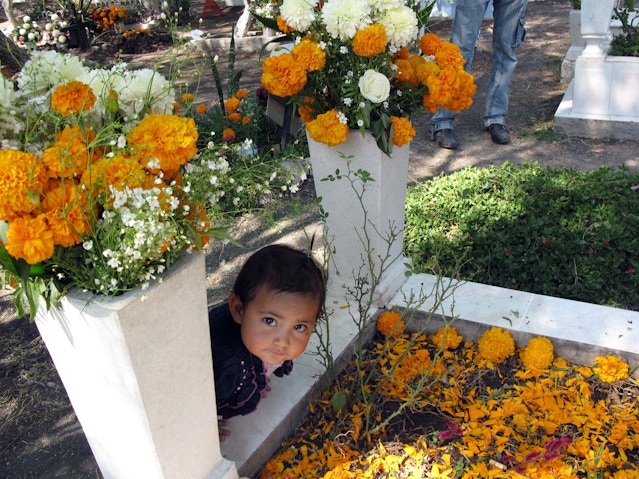
In the public cemetery, in Santiago de Queretaro, I hide behind mausoleums, snapping private moments. A woman bends over a grave, clipping the grass that’s grown wild over her father’s head; a man digs into the earth planting marigolds, bursts of orange  
bright enough to attract 
the spirits back.


A baby girl, the next generation, plays peek-a-boo between marble urns. Young men carry buckets of water from the well to the gravesites, 10 pesos to cleanse your tomb, honor your dead.


It’s a big day for the mariachis. 50, 100, 200 pesos a canciĂłn. Families are happy to pay a hefty price to conjure the ghosts of their loved-ones. Duos, trios, quartets cluster around the grave-sites playing happy songs with somber faces, as family members sing along, tears filling their eyes, remembering the time their mama danced to that tune.


I’m a voyeur; but I come out from the shadows to buy my own songs. I have dead loved ones too. I choose a trio: accordion, guitar, and upright base. I request Cielito Lindo, little beautiful sky, for my cousin, Jonny Copp, who died the summer before getting too close to the clouds. At age 35, climbing virgin peaks on the border between China and Tibet, he was buried alive in an avalanche.


Ay, yai yai yai, can-ta, no llores. Sing, don’t cry.

A couple lays a picnic upon a freshly washed marble grave: an embroidered cloth, plates of warm tamales wrapped in corn husks, and cabritos of tequila, little tiny shots of fire that take their sorrow away.


Sunday, July 12, 2015

Coming Clean

Today I’m coming clean with you, dear readers, and with myself. I’m not going to complete My Mexico Book by the end of the summer, or even by the end of this year.
This writing process is taking its own damn time. 
It reminds me of a hiking trip I took, years ago, along the Na Pali Coast, on the island of Kauai. It was hours of climbing before I reached the summit where the overlook was presumably one of the most spectacular in the world. But a bank of fog had rolled in and sat heavy. All I could see was an expanse of white nothingness, not the slightest sign of life below, no matter how hard I squinted. It was a huge disappointment.
After some food and a short rest, I turned to hike home and, just then, in my periphery, caught a tiny glimpse of green. I fixed my gaze; and second by second, the curtain of fog gradually drew, revealing a dizzying scene, not just a valley, but a valley of valleys, lush accordion folds of land stretching horizontally beyond my vision and cascading down into an endless indigo sea. With more illumination came the definition of individual palm trees, then the fronds themselves, village huts, farm animals and rows of crops, a fine horizon line separating earth and sky, tiny whitecaps gleaming like diamonds and bursting fluffs of cloud above.
This expansive and intricate world was always there; but it took time to reveal itself. (30 years later, incidentally, that image has never left my mind.)
That’s what it feels like writing this book. There’s this bank of fog. The further I get from the action of my Peace Corps Mexico experience, high above it looking down, and the more time I spend in the chair patiently writing through the haze, the more I begin to see what my book is really about. And then the writing flows.
Anne Dillard, in The Writing Life, puts it this way:
"It takes years to write a book – between two and ten years. Less is so rare as to be statistically insignificant…Falkner wrote As I Lay Dying in six weeks. He claimed he wrote it in his spare time from a 12-hour-a-day manual labor job. Some people lift cars too. Others go over Niagara Falls in barrels or fly planes through the Arc de Triumph…Out of a human population on earth of four and a half billion, only about 20 can write a serious book in a year. There is no call to take human extremes as norms.”
Pfew. 
This does not mean I’m letting myself off the hook with my Mexico book, just relieving some pressure, allowing the process to do its thing. Here’s what I am doing to encourage it along:
  • Cut-back my SeeChange consulting work in March, taking-on only a few select coaching and facilitation clients through the end of the year in order to maintain focus on the book.
  • Following a schedule of writing 6 days a week, 3 to 5 hours a day, employing the butt-in-chair approach, regardless of the weather or barometric pressure.
  • Completed a writing class at The Writers Center in Bethesda and came away with some helpful and lots of challenging feedback on the manuscript. (More on this excruciating experience in my next post.)
  • Admitted to myself (with the help of a good writing friend): I’m still in the DRAFT stage. Being more realistic softens the voice of the critic, allowing space for the ideas to flow.
  • Partnering with this aforementioned writing friend to keep ourselves accountable with weekly goal-setting and progress-reporting Skype sessions. (Still don’t need to get out of my PJs for those.)
  • Researching editors to work with me on my first and subsequent drafts. A big chunk of the Kickstarter campaign funding has been set aside for just this purpose.
Still, dear backers, I did commit during my November 2013 campaign to have the book completed and published LAST summer. 6 months, totally unrealistic! (I should have read Dillard first.) Yet it was a promise.
Therefore, I’m going to let you off the hook by offering to refund your pledge. Please let me know, and I will happily send you your money.
Otherwise, if you're in for the long-haul, and I sure hope you are, I can promise you this: I will have the first two chapters (or up to 100 pages) of the book available to you in PDF format by this Christmas, 2015. And I'll welcome your feedback.
For those whose rewards included social gathering/sustainability events, stay tuned for save-the-date announcements for the fall.
I’m learning a lot through this process about integrity and commitment – it’s not just about the creativity. Huh, it's my Peace Corps sustainability lessons all over again.
Many thanks for your continued support.  More to come!
                                                              ~~~
What's your reaction to my 'coming clean' proposal? What do you think about time and the creative process? 
What experiences have you had with your own creative projects?
 Your questions and comments are encouraged.

Wednesday, June 3, 2015

Kill Your Darlings

It’s been a while since my last Kickstarter update.  (Sound like the beginning of a confession?) Well, I’ve got good news to report. No, I’m not quite done with my book. But I have emerged out of the Survive section and into Thrive.

Pfew. It was a long haul. Like being stuck in the Molasses Swamp, that first year of my service was messy. Turns out it’s been almost as difficult to write my way through it as to have lived it!

Now that I’m getting into the rhythm of Thrive, I’m discovering: this is the story. I’m in the flow of the narrative for the first time since I started my book. And here's the tough truth: It’s possible that all I’ve written so far, over the past two years, does not belong in this book.

It may very well be BACKstory.

What is backstory, you ask? It’s the circumstantial detail that leads up to and supports the primary narrative.

The question is: Where does my Mexico story really begin? Try this:

     Why was it we always went a little further? Past the pobre but slightly cheery pueblito, a few cows and pigs and chickens in the yards, meat a sign of affluence; a road of dirt, but smooth and tree-lined for at least a block or two; a prim escuela with a painted swing set out back and a flat, pink, cutout adobe church with saint’s day fiesta flags flapping in the breeze.


     ‘Is this it?’ I asked the engineers, squirming like an impatient kid in the backseat.

      ‘Todovia no,’ they shook their heads. ‘Pero cerca.’

      Close. But by then we’d already been on the road for three hours, traveling east from Rioverde along the rim of the San Ciro flood plain, through the cutout in the mountain, then north at the Rayon crossroads, deep into the rocky arid lands where nothing grew but spikey things – pitaya, yucca, nopal – the camels of the plant world. The roads were eerily vacant out there except for an occasional pair of muchachos, baking in the sun, filling potholes with dirt and hoping for some pesos in return for their service.

     ‘Never stop for these guys, Anna,’ Bibiano warned me. ‘Es peligroso.’

     But when we got to the Federale roadblock, we had no choice but to pull over. I held my breath as the camouflaged men with machine guns over their shoulders and masks covering their faces questioned the engineers. A separate crew circled the truck, inspecting the undercarriage with mirrors. Supposedly a sign that the government had things under control, these checkpoints only reminded me there was a problem; and it was creeping south into my state. Who really knew how much longer Uncle Sam would allow me to carry-on here? When they waved us on, I exhaled, hoping I’d never have occasion to travel out here alone.

      This was my first trip to Zamachihue, an ejido community in the northeast corner of the Scotty Dog state, on the Tamulipus border, in the municipio of Ciudad de Maiz. ‘Neither a city nor do they grow corn,’ the engineers pointed out, chuckling at their irony.

      Bibiano took a hard right off the main drag and descended into a dry arroyo that could have swallowed us up, or pitched us over, our tires spinning on the loose clay. I gripped my handle tighter and felt the sweat rise on my brow. I’d never been a particularly pacific passenger; but this was beginning to feel like a test. The shade trees had disappeared, the breeze had stopped, and the sun burned the vacant plain littered with rocks. Our radio signal faded and all that was left was static. That’s when we hit a hole that threw me upward, my head banging the roof and my stomach plummeting.

     I felt a metallic taste rise in my mouth. ‘Pare!’ I yelled, opening my door as the truck skidded to a stop and expelling my breakfast onto the ground.

     One of the engineers passed me a handkerchief to wipe my mouth.

     When I looked up, there was the sign, rusted and dangling from a crooked post like something out of a Luis Estrada film. ‘Za-ma-chee-hwee.’ I’d written the name phonetically in my notebook.

     By the time we pulled-up to the vivero and parked in the tiny patch of shade offered by a scraggly mesquite tree, it seemed like we’d just reached the last effing pueblito on earth.

Maybe that’s the beginning.

Not the wintery night at Guapo’s in DC, drinking margaritas with my RPCV pal Beth and deciding, YES, damn-it, I’m going to apply to the Peace Corps. Nor is it my bright-eyed arrival in Mexico City eight months later or my three beginner’s mind months of Peace Corps training. It may not even be my entire first roller-coaster year as a volunteer, adapting to life in my new desert pueblito.

What if ALL that was backstory? It would mean I’d have to seriously ‘kill some darlings’ in order to give you readers the real meat. Sage advice from William Faulkner, it speaks to the many favorite moments and turns of phrase we've crammed in, pruned and polished. But if they don’t serve the story, advance the plot, get your darn character to the finish line, they’ve got to go.

Honestly, it’s too soon to tell. Right now, I have to JUST KEEP GOING. This is my guiding mantra, scribbled on a purple post-it and stuck on the cover of my writing folder so I see it every day.

There will be time to go back and reread and rewrite, edit and chop and prune. But not right now. Not until I write through to the end.

So I’m strapping on my Chocos. It’s time to get back out to the campo with the Engeneiros and get those seeds planted.
                                                                        ~~~
Dear readers, please post a comment. What do you say about darlings? Where does the story begin for you?  What do you need to know about your fearless/ful narrator?